Póster de guía de identidad de marca
Un tablero de presentación de sistema de identidad de marca que muestra el diseño del logotipo, la paleta de colores, la tipografía y aplicaciones de marca.
Los modelos económicos no renderizan tipografía de forma fiable; este caso necesita un nivel superior.
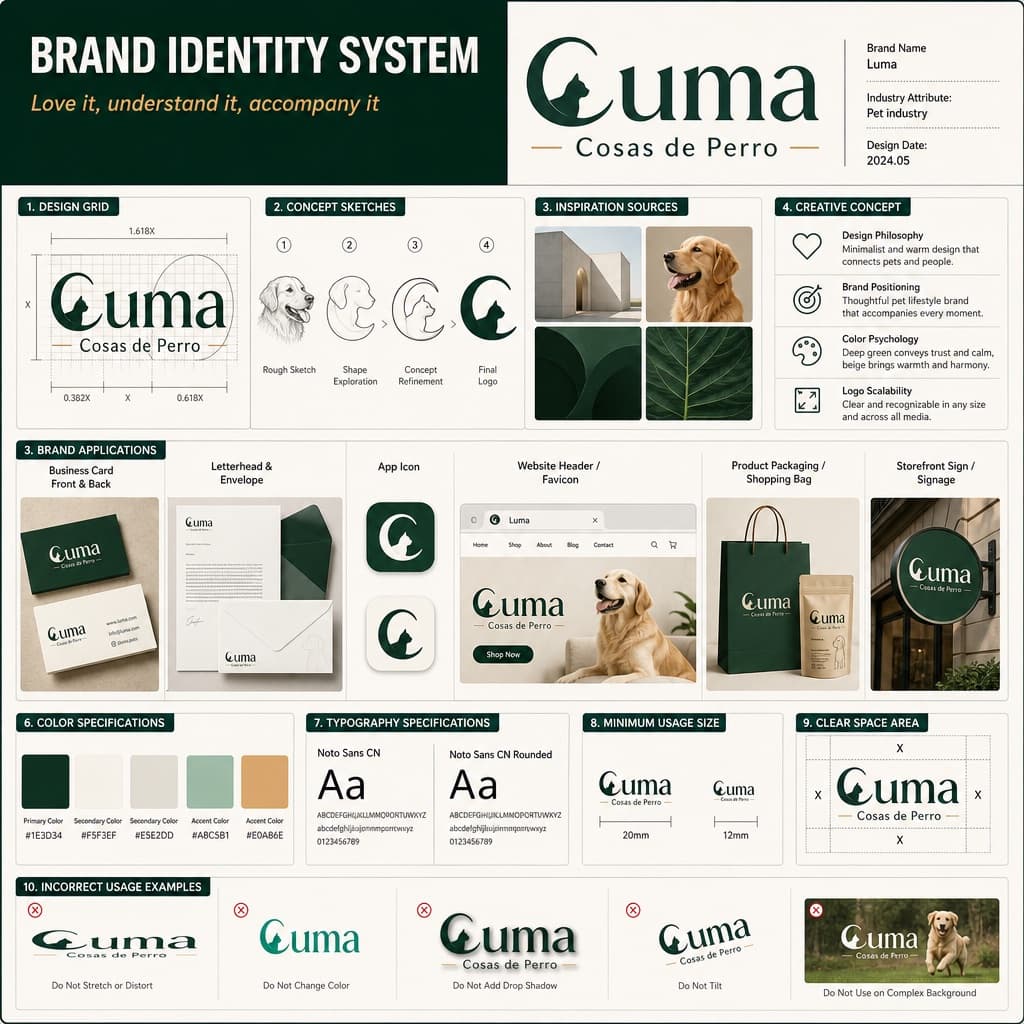
Imagen generada por nosotros con gpt-image-2. Prompt de @yyyole
Prompt
Design a brand identity system presentation board (UI poster style, realistic render), similar to a professional brand guideline deck used for client presentations.

Header: title text 'BRAND IDENTITY SYSTEM', with slogan text '[SLOGAN]' displayed beneath it.

Main logo section: primary logotype text '[BRAND_NAME]' with subtitle '[BRAND_CHINESE_NAME]', design feature described as [MAIN_SUBJECT]. Metadata labels beside the logo read: 'Brand Name', 'Industry Attribute: [INDUSTRY]', and 'Design Date: 2024.05'.

Layout sections arranged in a structured grid:
1. Design Grid (1 item): the logo displayed with architectural grid lines and golden ratio measurement guides.
2. Concept Sketches (4 items): evolution steps showing progression from a rough dog sketch to the final geometric logo.
3. Inspiration Sources (4 items): a moodboard with images including minimalist architecture, a golden retriever dog, and dark green geometric shapes.
4. Creative Concept (4 items): text blocks paired with minimalist icons explaining the design philosophy, brand positioning, color psychology, and logo scalability.
5. Brand Applications (6 items) labeled: 'Business Card Front & Back', 'Letterhead & Envelope', 'App Icon', 'Website Header / Favicon', 'Product Packaging / Shopping Bag', and 'Storefront Sign / Signage'. Mockups show business cards, envelopes, app icons, a website header featuring a dog, paper shopping bags, and a storefront sign.
6. Color Specifications (5 swatches) labeled 'Primary Color', 'Secondary Color', 'Accent Color', with color values: [PRIMARY_COLOR], #F5F3EF, #E5E2DD, #A8C5B1, #E0A86E.
7. Typography Specifications (2 samples) labeled '[FONT_NAME_1]' and '[FONT_NAME_2]', showing typography specimens with 'Aa', the full alphabet, and numerals.
8. Minimum Usage Size (2 items): minimum logo size specifications shown at 20mm and 12mm.
9. Clear Space Area (1 item): the logo surrounded by a bounding box with 'X' markers indicating required clear space margins.
10. Incorrect Usage Examples (5 items) labeled: 'Do Not Stretch or Distort', 'Do Not Change Color', 'Do Not Add Drop Shadow', 'Do Not Tilt', and 'Do Not Use on Complex Background'. Show examples of incorrect logo usage: stretched, wrong color, with a drop shadow, tilted, and placed over a busy photographic background.

Overall style: clean, professional grid layout typical of a modern brand guideline board, realistic UI poster rendering with balanced whitespace and consistent typographic hierarchy.
Quedan 8 huecos sin rellenar. Si copias así, el generador dibujará los corchetes tal cual dentro de la imagen.
Variables editables
Cambia cualquier valor y el prompt se reescribe arriba. Copia el resultado ya listo.
El nombre principal de la marca que aparece en el logotipo.
Un subtítulo secundario que aparece bajo el logotipo principal, puede estar en cualquier idioma.
El concepto de diseño o motivo visual central utilizado en la marca del logotipo.
El sector industrial al que pertenece la marca.
Código hexadecimal del color principal de la marca.
El eslogan corto de la marca que aparece en el encabezado.
Nombre de la tipografía principal utilizada en la especificación tipográfica de la marca.
Nombre de la tipografía secundaria o de estilo suave utilizada junto a la tipografía principal.
Genera la imagen aquí
Con tu propia clave de OpenAI. Gratis para nosotros, lo que gastes es tuyo.
Se guarda solo en este navegador y va directa a la API de OpenAI: no pasa por ningún servidor nuestro, porque no hay ninguno en medio. Puedes comprobarlo en la pestaña de red del inspector.
Rellena las variables que quedan antes de generar: si no, el modelo dibujará los corchetes.