Concepto de silla de papel arrugado
Un panel de diseño industrial en varias etapas que transforma una bola de papel arrugado en un concepto de silla ergonómica y escultórica con especificaciones técnicas.
Nivel mínimo: free0 variables editables
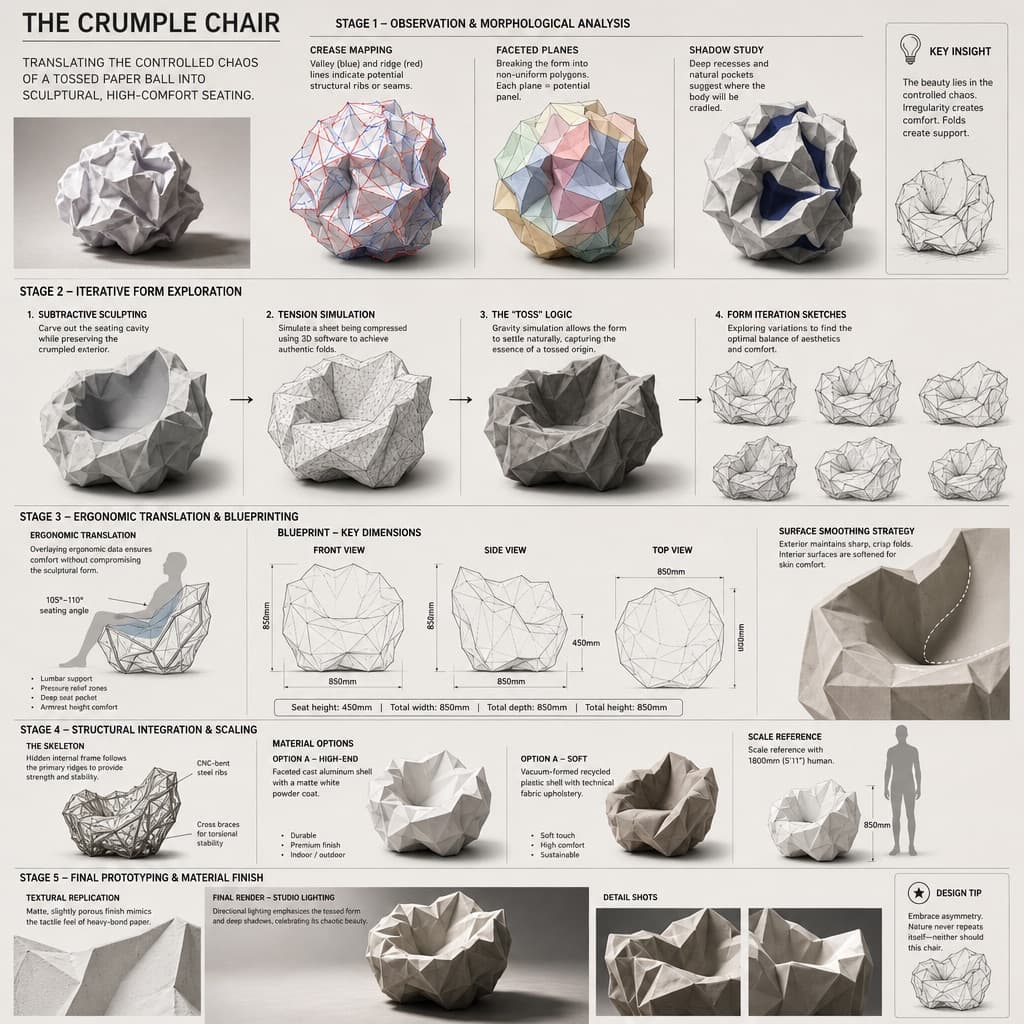
Imagen generada por nosotros con gpt-image-2. Prompt de @ShamsAmin56
Prompt
Design concept board: The Crumple Chair. Core philosophy: translate the 'controlled chaos' of a tossed paper ball into a sculptural, high-comfort seating experience.

Stage 1 — Observation & Morphological Analysis: Deconstruct the image of the crumpled paper into usable geometric data. Crease mapping — identify the primary 'valley' and 'ridge' lines, representing potential structural ribs or seams in the chair. Faceted planes — break down the sphere into a series of non-uniform polygons; each flat surface of the paper becomes a potential panel for the chair's upholstery or shell. Shadow study — analyze how the 'tossed' form creates deep recesses; these natural pockets guide where the user's weight will be cradled.

Stage 2 — Iterative Form Exploration: Move from a sphere to a seat through 'digital crumpling.' Subtractive sculpting — imagine the paper ball as a solid mass and use boolean operations to carve out a seating cavity that fits the human form while maintaining the external jagged texture. Tension simulation — use 3D software such as [3D_SOFTWARE] to simulate a flat sheet of material being compressed, ensuring the folds look authentic rather than 'modeled.' The 'toss' logic — experiment with gravity-based simulation, dropping a digital mesh to see how it settles naturally, mimicking the tossed origin.

Stage 3 — Ergonomic Translation & Blueprinting: Refine the raw aesthetic into a functional object. The comfort core — overlay a standard ergonomic template (seating angle: 105°–110°) over the crumpled form, adjusting the internal 'folds' to provide lumbar support and pressure relief. Blueprint generation — create technical orthographic views (front, side, top) mapping out dimensions: seat height 450mm, total width 850mm. Surface smoothing — maintain the sharp 'paper edges' on the exterior shell while softening the interior contact points for skin comfort.

Stage 4 — Structural Integration & Scaling: Make the concept physically viable. The skeleton — design a hidden internal frame (likely CNC-bent steel rods or a 3D-printed lattice) that follows the most prominent ridges of the paper folds to provide rigidity. Material selection — Option A (high-end): faceted, cast aluminum with a white powder coat; Option B (soft): vacuum-formed recycled plastic shell covered in 'memory-fold' technical fabric that retains a wrinkled appearance.

Stage 5 — Final Prototyping & Material Finish: Textural replication — apply a matte, slightly porous finish to the material to mimic the tactile feel of heavy-bond paper. Lighting contrast — use directional studio lighting in the final renders to emphasize the 'tossed' shadows, making the chair look like a giant piece of discarded inspiration. Design tip — to keep the 'tossed' look authentic, avoid symmetry; the most compelling aspect of a crumpled paper ball is its unique irregularity, so ensure the left and right sides of the chair are balance-equivalent but not identical.
Genera la imagen aquí
Con tu propia clave de OpenAI. Gratis para nosotros, lo que gastes es tuyo.
Se guarda solo en este navegador y va directa a la API de OpenAI: no pasa por ningún servidor nuestro, porque no hay ninguno en medio. Puedes comprobarlo en la pestaña de red del inspector.